

Hygiene for Food 2027 meets Factory of the Future - Dag 1 Inspiration4Food
Hygiene for Food 2027 meets Factory of the Future - Dag 1 Inspiration4Food
BMCC Brugge
With the support of:

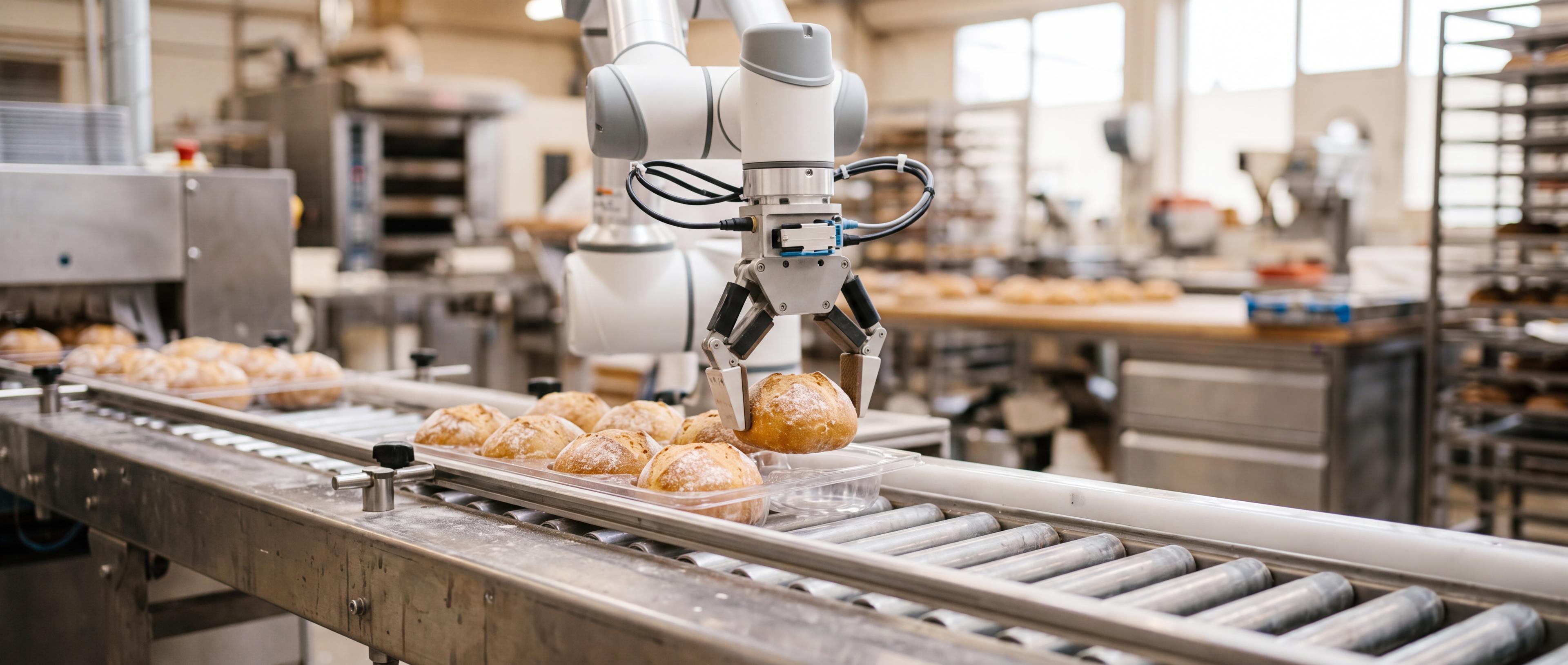
This project accelerates the adoption of AI-cobots in SMEs by supporting companies in assessing the feasibility, implementation and valorisation of flexible robotic automation.
The need for automation in food companies remains urgent in a context of labour shortages and high labour costs. At the same time, the increasingly diverse product range makes meeting this demand particularly challenging. Flexible pick-and-place tasks, in particular, remain difficult to automate. Recent developments in AI-driven cobots offer a solution: thanks to AI-powered vision systems, these robots can autonomously identify, pick and place objects in dynamic production environments. This makes them suitable for high-mix, low-volume production without the need for complex programming or specialist expertise.
The ARISE project supports food companies and robot integrators in the successful deployment of AI-driven cobots for flexible pick-and-place applications. Through practical tools, validation activities and real-life use cases, the project demonstrates how AI-powered cobots can enable cost-effective automation in highly variable production environments.
With this TETRA project, AP University of Applied Sciences and Arts and Ghent University are supporting food companies in exploring, evaluating, and implementing AI-driven cobots for flexible pick-and-place applications in challenging production environments. The project aims to lower the barriers for deploying AI cobots by giving companies insight into the possibilities, economic benefits, and organizational impact of this technology. ARISE focuses on:
The target audience is twofold:
Ghent University is the VAIOP partner within the consortium, with the AIRO team of the IDLab research group contributing to the project. Flanders Food acts as a subcontractor and supports the project coordinator, AP University of Applied Sciences and Arts, in the dissemination of project knowledge and results.

To ensure that the project results are as relevant as possible for the food industry, a steering group is being set up within the project, bringing together representatives from food companies and technology providers. Companies interested in participating can contact the Project Manager, Kevin Diependaele, at AP University of Applied Sciences and Arts.